How Climbing Footwear Inspired Skateboarding's Most Exciting New Shoe Brand

How Climbing Footwear Inspired Skateboarding's Most Exciting New Shoe Brand

Author
Based between Paris and the Alps, French brand Village PM is borrowing from climbing to build something skateboarding hasn't seen in decades

Published: 03-31-2026

Updated: 04-02-2026

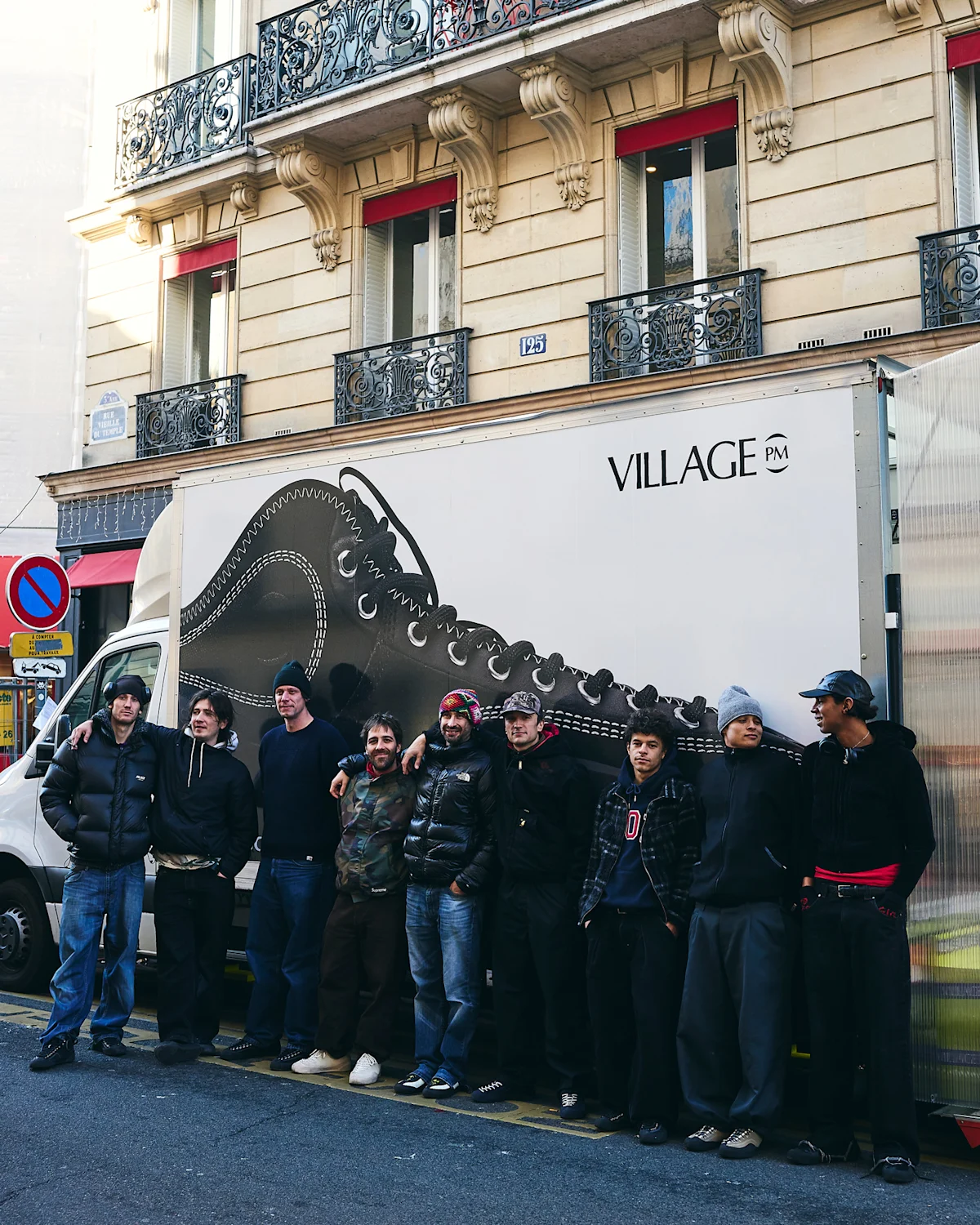
Village PM seemed to pop up overnight. If you're into sneaker culture or skateboarding, maybe you heard the brand's name whispered by those in the know over the past couple years. But after Paris Fashion Week in fall 2025, where the company showed up in Le Marais, guerilla style, with a box truck-turned-showroom, suddenly everyone in the outdoor-curious shoe world knew about the up-and-coming footwear based between Paris and the French Alps.

Before you let the climbing-adjacent aesthetics of the brand's flagship shoe, the 1PM, fool you—yes, that rubber wrap does read like something you'd see on a traditional rock climbing shoe—know that Village PM is first and foremost a skate brand. But by rethinking traditional footwear design and borrowing from the materials and construction of outdoor sports, the small team behind it has an entirely different idea of what a skate brand, and a skate shoe, could look like.

village-pm-1pm

Village PM's 1PM skateboard shoe

Founders Basile Lapray and Bram De Cleen met through skateboarding, though each brings a different perspective to the brand. De Cleen brings a lifelong devotion to skateboarding to the operation. He rode for the French brand Öctagon and Carhartt WIP, wrote for skate magazines, and spent nearly a decade building skateparks across Europe. Those years shaping concrete and then watching it get used and abused the way it’s supposed to be proved formative.

Lapray skates, too, of course, but his expertise is in footwear design. Before Village PM, he worked across the industry at brands including Salomon before eventually landing at All Triangles, a footwear innovation agency founded by Julien Traverse in Annecy, at the foot of the French Alps. Traverse is known in the industry for his work developing advanced footwear concepts for outdoor and performance brands like The North Face.

Just up the valley from Annecy is Chamonix, where Lapray visited frequently to hike, scramble, and explore the legendary valley. That connection to the mountains never really left him; when you spend a childhood moving through that kind of terrain and later work in outdoor footwear R&D, developing and prototyping shoes for brands like TNF and Paraboot, you start thinking differently about how shoes are supposed to work.

Together, the pair had all the ingredients to reinvent the stale category that skate shoes had become.

chuttersnap-skate-shoes-unsplash

Photo by CHUTTERSNAP via Unsplash

The Last Era of Skate Shoes

Climbing and skateboarding have more in common than sticky outsole rubber. Both sports attract an obsessive clientele driven by creative problem solving through repetitive failure. They're also both deeply, almost unreasonably particular about their footwear.

The relationship between shoe and ground is too important to treat casually. Neither climber nor skater is going to accept a shoe on aesthetic alone. It has to actually perform. But to understand why Village PM’s first shoe, the 1PM, landed with so much noise, it helps to know what came before it.

In the 1990s, skateboarding footwear was largely built by skater-owned brands. Companies like Soul Tech, the parent company behind Emerica, DVS, Lakai, and éS, produced shoes that drew heavily on the visual language of Converse and Vans—flat soles and suede uppers.

Vans helped cement the dominant construction method. Their early skate models, including the Era, introduced in 1976, and later the Old Skool, used vulcanized construction, a process where the rubber outsole is heat-bonded directly to the upper during curing. The result is a thinner, more flexible sole that delivers the kind of board feel skaters depend on, and that design has dominated ever since. There have been occasional departures. In the mid-2000s, a slew of designs drew heavily from basketball footwear—Lakai Telford, éS Koston 3, DC Reason for example—adding a cushioned collar and bulkier proportions with a glued or stitched-on pre-molded cupsole that added padding for jumping down gaps and stair sets.

"We wouldn’t have quit everything to start another brand if we didn’t feel we had something powerful to propose."

When Nike and Adidas caught on to the skate scene in the early 2000s, most of the genuine innovation began coming from the world's two largest footwear companies. Both brands worked closely with professional skaters and built legitimate teams, but they also brought deep design resources and a vast global manufacturing infrastructure. Smaller skate companies struggled to match the scale. Many independent brands simply couldn’t compete and were gradually bought or folded into larger groups.

Nike and Adidas have been responsible for some of the most influential and innovative skate shoes of the past two decades. Eric Koston’s Nike SB Hyperfeel series and Dennis Busenitz’s signature Adidas model both pushed skate footwear forward in terms of cushioning and fit. Increasingly, the technical development was taking place inside large corporate design labs rather than within skater-owned companies.

Skater-owned brands largely faded from shop shelves and skateparks. Outliers are hard to find, with one recent exception in Sweden’s Last Resort AB. The brand was founded by Polar Skate Co.’s Pontus Alv and Sami Tolppi as a direct response to the corporatization of the skate shoe, though they still largely work within the familiar language of flat, vulcanized soles. For all the evolution that's happened in other footwear categories—in materials and styling—most skate shoes still rely on the same old construction they have for decades.

And yet, there are few other sports that hold footwear to such a high standard of feel and performance. Village PM is the first to take a new approach to the sport in a long time.

village-pm-purple

Village PM's Outdoor-Inspired Breakthrough

Lapray and De Cleen had been thinking about starting a skate brand for a long time, but they weren’t about to quit their jobs just to add another familiar silhouette to an already crowded wall. If they were going to do it, their point of view needed to show up in the product itself.

"We wouldn’t have quit everything to start another brand if we didn’t feel we had something powerful to propose," Lapray told Field Mag. "If we were going to do it, it had to solve a real problem."

That meant rethinking the part of the skate shoe that fails first—anyone who skates knows the front of the shoe is where the damage happens. Ollies and flick tricks wear down the same abrasion zone until the upper eventually shreds to pieces.

The answer became what Lapray and De Cleen call the rubber glove construction, a wrap that shields the high-wear area at the front of the shoe. Where traditional skateboard footwear has largely revolved around the previously mentioned vulcanized construction or cupsole construction. Village PM sits somewhere between them, borrowing from both without getting boxed into either.

Matteo-Challe-village-pm-rand

Photo by Matteo Challe courtesy Village PM

Matteo-Challe-village-pm-workshop

Photo by Matteo Challe courtesy Village PM

Getting the right balance in that rubber matters enormously. Too stiff and you lose board feel, too soft and it shreds quickly, too sticky and the shoe starts behaving wrong. The whole thing is a tightrope walk between durability and sensitivity. To walk it perfectly, De Cleen and Lapray did a lot of testing.

In the lead-up to launching Village PM, Lapray would stay late at his nine to five at All Triangles to work on prototypes. He bought pairs of mainstream skate shoes, cut them apart, and replaced sections with experimental rubber compounds sourced from different suppliers. Then he'd hand them off to De Cleen for the only test that counts in skateboarding: skating. They ran that lab-to-street loop until they found something that held up without wrecking the feel that makes a skate shoe worth wearing. "Everything on the shoe can be justified by function," Lapray said.

village-pm-gray

The 1PM

village-pm-mid-gray

The 1PM Mid

A New Sort of Skate Shoe

In March 2025, the pair officially launched the brand with two models, the 1PM and the 1.30PM. Both share the same rubber glove construction and asymmetrical fit, with the 1PM acting as the fully equipped version and the 1.30PM refining the same concept into a cleaner, slightly more minimal silhouette. When the first pairs began circulating through Paris skate shops like Nozbone, the unfamiliar construction caught the attention of skaters used to seeing the same silhouettes year after year. Where most skate shoes flatten out and wear through at the toe, the 1PM wraps that zone entirely, the rubber hugging the forefoot in a way that reads like a climbing shoe and skates like nothing else in the market.

The rubber wrap brings with it another idea more common in climbing than skateboarding: repairability. Because the rubber glove wrap is a separate component, it can be replaced once it wears down rather than throwing the entire shoe away. Village PM doesn’t currently offer its own repair service, but the process isn't proprietary. "You can go to any cobbler, or the same place you’d repair climbing shoes," Lapray told us. "They’ll take a sheet of rubber, die-cut a new piece, and replace it."
village-pm-paris-fashion-week

From left to right: Oscar Säfström, Elliot Bonnabel (filmer), Bram De Cleen (co-founder), Joffrey Morel, Basile Lapray (co-founder), Nico Gisonno, Logan Da Silva Ortiz, Jérôme Sossou, Thaynan Costa | Courtesy Village PM

The forefoot takes the beating, so that’s the part you repair. Lapray actually likes that the replacement might use a different rubber compound than the original. "Maybe it won’t have exactly the same performance," he said, "but that’s where the beauty is. The shoe takes on its own character." It’s a philosophy long embedded in climbing; extending the life of the shoe in a way that feels old-school and DIY.

Heading into Summer 2026, the brand is introducing new colorways of the 1PM and rough canvas versions of the 1.30PM. It's also launching the shoe people have been waiting for, the 1PM Mid, a twist on the company's first model with some extra cushion and support. The new model is a mid-top evolution of their core silhouette, with the same climbing-inspired design that includes the rubber glove construction and asymmetrical precision fit with full foot lacing, but now with a padded collar that sits low in the back for easy entry.

It wasn't long after launch that Village PM achieved cult status, gaining word-of-mouth attention slowly, and then all at once with Paris Fashion Week (where many outdoor brands have begun showing). Now with their latest drop, momentum is only increasing. The hype is expanding beyond the company's European borders, too.

Soon, its skate shoes will be on their way to Japan and Canada through shops like PROV, BEAMS, and Dover Street Market Ginza. But the team behind it remains small, with Lapray and De Cleen managing the brand and design, plus Lapray's sister on the business side, as essential to the operation as either founder. Skateboarding, after all, has always been communal.

For a shoe that seemed to appear from nowhere, it's been a long time coming.

See the mountains that helped inspire the brand with our hiking guide to the Tour du Mont Blanc.