A Legacy Brand Rebuilding
Diadora was founded in 1948, in Caerano di San Marco, an hour towards the Alps from Venice, as a mountain boot manufacturer, originally producing handmade hiking footwear before expanding into a range of speciality sports.
After the aforementioned troubles attributed to globalization, ill advised category expansion, and many others, in 2009, Enrico Moretti Polegato and his father Mario, founder of Italian lifestyle shoe brand Geox, acquired Diadora. The pair were drawn to the company by its long history, and the potential for it to become a global leader once again.
“Diadora is a brand that has always been focused on technology, on improving the performance of the athletes, on being at the service of the athletes with their products,” the younger Polegato tells me. “It was a unique blend of high-end technology and Italian style. This was the key for a brand to enter a very competitive market like the sports market.”
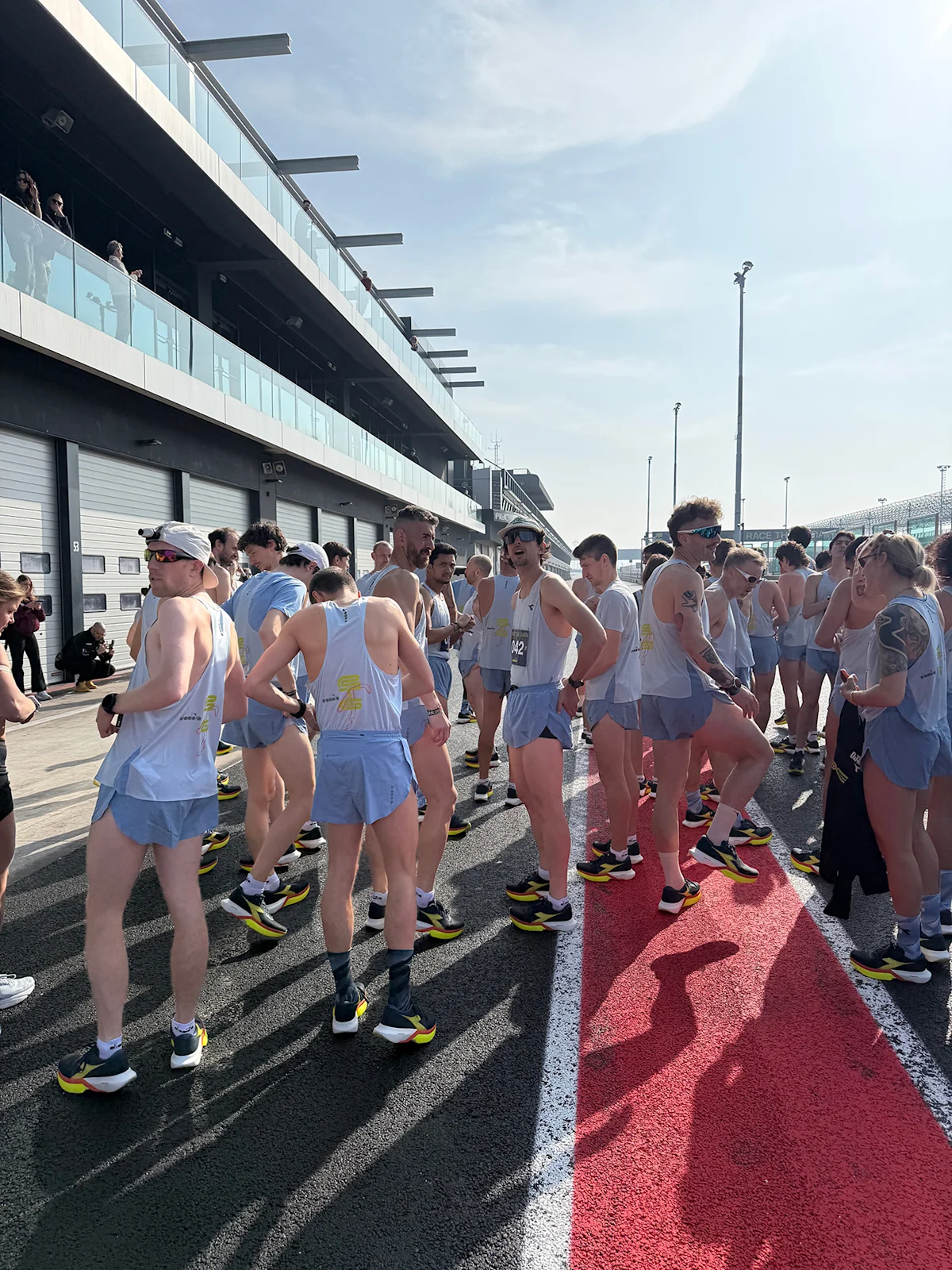
Gearing up for Race the Gara | Photo by Hannah Singleton
This time around, Polegato would hone in on fewer, key sports that he felt the brand had real expertise in: running, tennis, and soccer. Another arm of Polegato’s approach is to lean into Diadora's heritage roots—that Italian style—by reviving archival silhouettes and maintaining Made in Italy production on select models.
“Every Italian lives in heritage, lives in beauty. We leave home and are surrounded by this history, by the obsession for beauty, for detail. So that thing comes automatically to us,” he says in characteristic fashion. “The attention to the detail, the material, the single stitching is part of us. We do it even without realizing it."
Inside the Modern Diadora HQ & Factory
Attention to detail and craft remains front and center at Diadora. When I visited the headquarters in Caerano San Marco, I saw the production line where the team manufactures their Made in Italy models, like the Atomo Star, a max-cushion shoe for daily running. Workers sanded rubber by hand, glued soles, and shaped the fabric uppers, all using techniques and machinery that the brand originally used in the '90s. Claudio Bora, Diadora's CEO, whose first job was on a production line just like this, even hopped in to demonstrate the process himself.
Next door to the factory, in the research and development lab, the innovation team puts running shoes through the paces using machines designed to simulate the thousands of strides that add up to a marathon. They can also test athletes' gait patterns on treadmills while collecting data about shoe performance and wear patterns.
Maintaining on-site manufacturing and a testing lab allows Diadora to experiment and tinker right in the foothills of the Dolomites. If an athlete heads out on a run and notices their heel slipping, or wants more cushion under the forefoot, it's easy to tweak the design. “You could adjust the stack height and you do it all in real time,” says Bryan Poerner, Diadora’s US CEO, who previously worked for Puma. “The actual process of creating a shoe actually happens in-house.” Even if a technical running shoe like the Gara Carbon 3 isn’t ultimately produced in Italy, it’s conceived and developed at HQ.
While pushing the edge of performance, Diadora isn't ignoring its extensive line of heritage models that nod to styles that were popular in the '90s and 2000s. Some, like the B.Elite, once the shoe of choice on the tennis circuit, are made in-house. Originally designed for Borg in 1978, today it's made as a lifestyle shoe. The Mythos 280 is another homage style, designed in collaboration with Bordin as a nod to the early 2000s running shoe he wore at his competitive peak.


