Starting from the Source with Adaptive Athletes
Professional adaptive skier and disability access strategist Vasu Sojitra understands what it means to modify and adapt more than most. Sojitra lost his right leg to an infection at nine months old and has spent his life finding creative ways to recreate outside. His specialized kit includes a pair of outriggers he uses to ski full-on backcountry lines and resort runs. Sojitra is an elite mountain athlete and became a member of The North Face's athlete team in 2018 after being brought on by Conrad Anker. His feats include a descent of Denali and an ascent of the Grand Teton, among many others.
As a vocal advocate and passionate outdoorist, Sojitra played an integral role in developing The North Face’s Universal Collection, the brand's first line of inclusive camping and outdoor gear, which launched in April 2026. The collection includes a tent, sleeping bag, daypack, slippers, and hat, stacked with adaptive features.
“The seed was planted on my very first visit to The North Face campus in 2017, when I asked the brand, 'Do you know what universal design is?' and, 'Have you ever tried setting up a tent from a wheelchair?'" Sojitra tells Field Mag. Sojitra describes his role as a “conduit,” explaining how he highlighted the untapped potential of the disability community both as an underserved sector of the industry and a demographic with serious spending power. “Twenty percent of the U.S. population has a disability,” he says, pointing out that “no other outdoor brand has done this yet.”
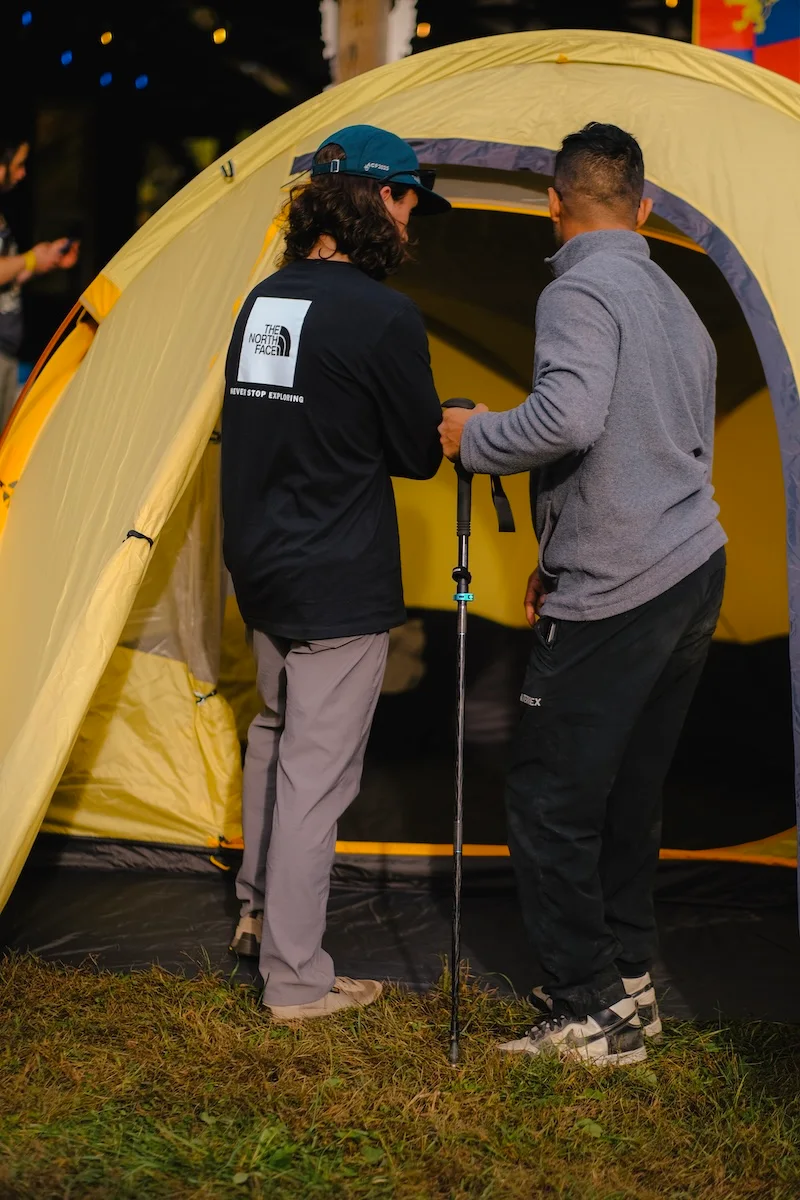
Checking out the Universal Wawona Tent | Courtesy The North Face
During development, The North Face worked closely with Sojitra and other adaptive athletes from their team, including professional climber Maureen Beck, and the broader adaptive sports community to co-create an innovative line focused on accessibility. “I was there to ensure this wasn’t going to be inspiration porn or a savior campaign, but an integrated effort with disabled voices at the forefront,” Sojitra says. “Not a separate adaptive line, but products designed to work for everyone.”
What’s interesting about the collection is how simple the innovations are. For example, the Universal One Bag ($280) is a zipperless sleeping bag that uses magnetic closures instead of a zipper and rubberized touchpoints for ease of use. The Universal Wawona 3-Person Tent ($435) has a larger entryway to accommodate mobility devices and oversized zipper pulls, also with rubberized, tactile features for intuitive use and bright colors for better visibility. The Universal Design Traction Mules ($65) are an updated version of the original camp slippers designed for better inclusivity thanks to a rubberized high traction sole, easy-to-see contrasting colors, and a unisex fit made to be worn on either left or right foot, and the Universal Daypack 20L ($140) has features like oversized grab handles, magnetic closures, a stand-up design, an adjustable torso to fit different bodies and most wheelchairs.
I had the chance to check out the sleeping bag and tent in my backyard, and found neither was glaringly different from traditional camping gear, which was Sojitra's point from the get-go. Then I took a closer look at the product details and understood how this series of relatively small design changes could enhance user experience for all kinds of people recreating outdoors. To put it differently, the adaptive features are fully integrated into the design, rather than additional or separate. And they work for everyone.
Luke Matthews, senior technical equipment designer at The North Face, voiced the theory in a press release for the Universal Collection: “The hallmarks of great design should provide a positive user experience from start to finish for all users."


