Barrel vs. Cube Sauna: Which One Should You Pick?

Barrel vs. Cube Sauna: Which One Should You Pick?

Author Photographer
  • Courtesy Nootka

Despite their similarities, these two styles of sauna are distinctly different. An expert sauna builder shares their advice for choosing the best one

Published: 09-23-2026

Presented by


The more you sauna, the more you begin to notice the finer points of the experience that can be at first (understandably) overshadowed by the whole being really, extremely hot thing. As a sauna devotée who built my own backyard sauna and has enjoyed countless sweat sessions through the years, I can attest, there’s more to a sauna than just beating the heat.

What keeps many of us coming back to the sauna time and again is the experience of really good heat; the kind that you relax into for long stretches to feel the tension unravel, hear the ambient sounds of nature, have a chat with a good friend, and let the mind chatter evaporate like steam hissing off hot rocks. The main player in creating that deep, all-encompassing heat is the sauna shape itself. Which is why the barrel and cube are two of the most popular outdoor home sauna designs (though of course, other styles exist).

But which is better, a barrel vs. cube sauna? What are the differences between these two similar sauna styles and how do you know which one to choose? To learn more, we spoke with the boutique builders at Nootka Saunas to settle this once and for all, diving deep into design, materials, different types of heat, and more.

barrel-versus-cube-sauna-guide-outdoor-fireplace

Cube vs Barrel Sauna: Which Should You Buy?

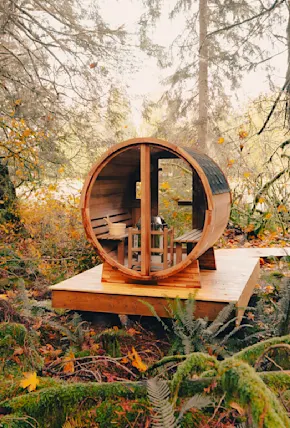
This guide will help you answer this question. But the TL;DR version is, it depends on several things: heat bathing style, heat source, and layout. A cube sauna is better for those who prefer tiered benches with the option to sit higher for more intense heat or lower for less heat. It’s also an aesthetic choice, with cubes often offering a more contemporary style. A barrel sauna is better for those who like a consistent temperature throughout the sauna and a single bench height. Barrels also heat up faster with natural convection. Design-wise, the barrel has a more rustic, traditional look. Nootka Saunas, the Squamish, BC-based builder we consulted for this guide, hand-crafts both styles from western red cedar and ships throughout the USA and Canada.

Read on to dive in deeper and develop a better understanding of what all that means below.

Barrel vs. Cube Sauna at a Glance

Shape

- Barrel: Cylindrical, organic form
- Cube: Modern take on the Finnish cabin

Heat Character

- Barrel: Consistent temperature via continuous convection current
- Cube: Stratified heat with hotter air up top, gentler below

Benches

- Barrel: Single height
- Cube: Two-tier, choose your intensity

Heat-up Time

- Barrel: 15-20 minutes
- Cube: 20-25 minutes

Heat Source

- Barrel: Electric heater or woodburning stove
- Cube: Typically electric heater only

Capacity:

- Barrel: 4-6 adults (depending on model size)
- Cube: 3-6 adults (depending on model size)

Best For:

- Barrel: Fast heat-up, even heat, wood-fired option, blending into an outdoor setting
- Cube: Traditional Finnish sauna experience, tiered heat options, contemporary architectural look

What is the Difference Between a Cube and Barrel Sauna?

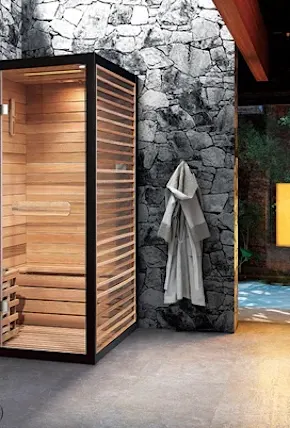
A cube sauna is a contemporary take on the traditional Finnish cabin-style sauna that blends together the rounded edges of a barrel sauna with the classic cabin shape for a modern look. The higher ceiling of a cube sauna makes it possible to house two bench heights for a more distinct stratification—or layers—of heat. This way, sauna users have two options: sit up high for more intense sweat or stick to the lower bench for a softer, gentler warmth.

The barrel sauna has a cylindrical shape designed for continuous convection flow in which air is constantly being recirculated. Since it doesn’t have corners, there’s no chance of cold air pockets, which is good news for those who want an efficient sauna that heats up fast. The barrel sauna is a nice-looking organic design, with a form that is more complementary to an outdoor setting rather than overpowering. Depending on your sightline and surroundings, a common add-on feature is a tinted glass window for sauna sits with a view.

“We will often see that people are between the two,” said Kris Harris, co-founder of Nootka Saunas, which crafts handmade saunas in Squamish, BC. As a former mechanical engineer and lifelong sauna user, Harris brings extensive knowledge and years of experience to Nootka that makes him an expert in sauna building, but also a trusted source on the art of heat bathing.

“Some sauna purists insist your feet need to be above the heater rocks. We don't strictly subscribe to that, but the cube sauna allows you to take the first few sessions on the higher bench and gradually make your way down to the lower bench for less heat,” said Harris. “By no means is the barrel sauna secondary to the cube. A well-designed barrel sauna is a different animal because it heats up really quickly and you’re not wasting any room on top with corners, so they get a really nice convection current through them.”

The difference maker often comes down to the layout of your outdoor space, like the sightlines, or existing architecture which may or may not compete with something like a cube’s linear roof and be better balanced by the barrel’s unique shape. All these deciding factors play a role in your final choice, but when it comes to sauna, it’s always the heat that matters most.

barrel-versus-cube-sauna-guide-cube-sauna-interior

Heating and Ventilation in Barrel and Cube Saunas

Good quality heat, steam, and circulation are arguably the most important pieces to get right in the sauna. The interplay of these three elements is what creates the ideal environment to keep that heat in motion, which means finding the right balance of temperature, humidity, and ventilation is essential.

The rounded shapes of barrel and cube saunas are primed for better air flow, so naturally, the Nootka team narrowed down their offerings to these two styles. Starting with the temperature, Nootka pays attention to the heat at every level, using a 24 gauge metal roof—the same kind used on houses—for a premium layer of insulation that outperforms many other roofing materials.

Both barrel and cube are compatible with an electric heater (the cube’s floor plan is too tight for a wood-burning stove), but according to Harris, it’s their specialty 9kW Nootka Electric Heater that really changes the game. “By slightly overpowering the heater, it gets hot really quickly, and begins to de-stratify the temperature,” explained Harris. “Whereas, other brands use a 6kW heater, but a smaller heater can struggle to keep temperature in the middle of winter, or while opening and closing the door.” As a result, Nootka boasts some of the fastest heat-up times, with just 15-20 minutes needed to bring their electric sauna up to temperature.

Ventilation systems keep air moving dynamically throughout the space to avoid stagnant air or sharp contrasts of hot and cold. The barrel’s design inherently promotes this through the convection current cycling around the interior, while the cube sauna requires a bit more help. That’s why Harris and his team designed a passive ventilation system for both models that ensures air is always cycling. “There’s a vent behind the heater and on the opposite side of the sauna that allows fresh air to come in and mix with the hot air rising from the heater so you don’t feel cold air coming into the sauna. This also helps to exhaust air from inside the sauna and regulate the pressure.”

While they overlap in many ways, it’s important to know how each style of sauna shapes the way air and humidity flow interact to create two different ways of heat bathing. Even though the cube sauna’s structure leans more heavily into the stratification of heat, Nootka’s method creates a more even heat gradient for a smoother transition between the different levels.

Then, in the barrel sauna, a strong and continuous convection current keeps sauna users enveloped in a steady flow of hot air and steam for a deep heat that settles into your body. Ultimately, it is up to the individual to decide which type of experience they want to have in the sauna.

Comparing Nootka’s Barrel and Cube Saunas

Nootka Saunas Barrel Sauna-thumbnail

Sauna Specs

Nootka Saunas Barrel Sauna-thumbnail

Nootka Saunas Barrel Sauna

Shop at Nootka Saunas
  • Heat Source Nootka Saunas Electric Heater or Harvia M3 wood-burning stove
  • Footprint 8ft Model: 94” L x 80” W x 82” H | 10ft Model: 118” L x 80” W x 82” H
  • Capacity 8ft: 4-person | 10ft: 6-person
  • Weight 1,450 lbs
  • Price (Nootka Saunas) ~$8,000 to $10,00
  • Manufactured In Canada
  • Available In Canada & USA

Nootka’s barrel sauna is offered in two sizes, 8 foot and 10 foot options, with both made entirely of naturally hydrophobic western red cedar—and without glues or chemicals. It features the proprietary 24 gauge galvanized aluminum roof, passive ventilation design, and a system that allows users to preheat their sauna using their smartphone and a sleek touchscreen. Every unit is hand-built in Squamish, British Columbia. It’s an affordable way to have an iconic barrel sauna in your backyard.

Nootka Saunas Cube Sauna-thumbnail

Sauna Specs

Nootka Saunas Cube Sauna-thumbnail

Nootka Saunas Cube Sauna

Shop at Nootka Saunas
  • Heat Source Nootka Saunas Electric heater only
  • Footprint 94” L x 80” W x 101” H
  • Capacity 5-person
  • Weight 2,350 lbs
  • Price (Nootka Saunas) ~$13,000 to $14,500
  • Manufactured In Canada
  • Available In Canada & USA

Perfect for those who want a traditional Finnish sauna design, Nootka’s cube sauna comfortably seats 5 adults and has a compact 6'5" x 8' footprint. Complete with two-tiered benches and a large tempered window, the cube sauna also offers the same system for users to preheat their sauna using their smartphone and a sleek touchscreen.

LEARN MORE

barrel-versus-cube-sauna-guide-lifestyle-model

Barrel vs. Cube Saunas FAQs

Are barrel saunas actually good?

A well-designed barrel sauna heats up most quickly and efficiently in comparison to cabin-style or cube saunas. Due to its cylindrical design, it eliminates cold air pockets by naturally trapping and circulating air well throughout the interior. The barrel sauna also boasts an aesthetic organic design that often complements an outdoor space rather than competing with existing architecture.

How long does a barrel sauna take to heat up?

A barrel sauna can take anywhere from 15 minutes to an hour to heat up depending on the heat source. An electric heater can get to temperature in under 20 minutes, while a wood-burning heater can take longer depending on the size of the sauna and the conditions.

Is a cube sauna better than a barrel sauna?

Neither is objectively better; they offer two different heat bathing experiences. A cube sauna gives you two bench heights, so you can choose between more intense heat up top or a gentler warmth below, and it suits smaller outdoor spaces. A barrel sauna delivers a consistent, evenly circulating heat thanks to its cylindrical shape and typically heats up faster. Builders like Nootka Saunas offer both styles for exactly this reason; the right pick comes down to your space and how you like to sweat.

How much does an outdoor sauna cost?

Expect a quality outdoor home sauna to cost roughly $8,000 to $15,000. As a reference point, Nootka Saunas’ hand-crafted western red cedar barrel sauna runs $8,475 to $9,125, and its cube sauna runs $13,250 to $14,640. Both are manufactured in Canada and available in the USA and Canada.

Can you put a wood-burning stove in a cube sauna?

Generally, no. Most cube saunas, including Nootka’s, have a floor plan too tight to safely accommodate the clearances a wood-burning stove requires, so they run an electric heater instead. Barrel saunas can typically be fitted with either an electric heater or a wood-burning stove, like the Harvia M3.

What is the best wood for an outdoor sauna?

Western red cedar is widely considered the best wood for outdoor saunas because it is naturally hydrophobic, rot-resistant, and stable through repeated cycles of heat and humidity. It is the wood Nootka Saunas uses for both its barrel and cube models, built without glues or chemicals.

Once you've decided on your preferred style of sauna, pair it with a vetted pool from our cold plunge guide for the full contrast therapy circuit experience